Thursday, October 18, 2007

Doctors click to networking

By Christopher Bowe in New York
Published: October 14 2007,

US doctors may not have time to be out of the office with colleagues playing golf anymore, but they might be found clicking away online (on a social networking site) instead.

And the demise of doctors’ weekday golf availability and their time on Sermo.com, the US social networking site for physicians, are very much related.

As the structure of medicine changes and more treatment is done in physician’s offices, allowing patients to avoid hospital stays – so-called outpatient treatment – doctors can spend more time there, and much less time than before interacting with peers.

Dr Daniel Palestrant, founder and chief executive of Sermo, says doctors’ increasing sense of isolation was one of the most unexpected findings after launching his social networking site a year ago.

“Golf is a thing of the past; even doctors’ lounges are things of the past. What was shocking to me was these doctors described themselves as ‘lonely’.”

But that is changing as doctors are now linking themselves and their practice of medicine in new ways with technology more often associated with teenagers than surgeons.

This shift is highlighted in the current collective discussion among Sermo’s online community of more than 30,000 physician members on what to call themselves. So far, they prefer “Sermoans”.

The Sermoans are medicine in the MySpace age. And it’s not just the younger set fresh from medical school. The attraction of belonging and the ability to publish or broadcast personal professional pursuits to a distinct and interactive online social community and receive feedback is grabbing the older, busiest doctors the most.

Dr Palestrant says he expected Sermo’s users to be dominated by younger doctors like himself at age 33. But instead, Sermo member doctors 45 years of age and older outnumber by three-to-one those under 45.

Sermo, which verifies each member’s credentials, is free to join for doctors, whose profiles can range from minimal biographical information to photos and personal details. Its business model rests on two fundamentals: no advertising and open, unedited interactions between members.

For instance, a doctor posts a medical case, and others help to work the problem. Other discussions can expose conflicts of interest in doctors, seek emotional support, or ask for guidance on hiring and firing office employees. “The wisdom of crowds dictates these things. It’s startling how effective this happens,” Dr Palestrant says.

Nevertheless, it was the prohibition of marketing and branding that at first left the pharmaceutical companies wondering how they could ever work on such a new frontier. Dr Palestrant estimates that nine months ago about 90 per cent of drugmakers he approached either thought Sermo was a joke, or looked for reasons why it would not work.

Pfizer was interested nine months ago, as the company struggling and in transition with Jeff Kindler, its new chief executive, sought fresh ideas.

Pfizer sees the technology as potentially helpful, efficient and a dynamic way of letting doctors obtain information on its drugs, learning more about its own drugs, improving relations with the medical community, and getting new ideas and feedback on clinical trials.

Dr Michael Berelowitz, global medical chief at Pfizer, said: “The most interesting thing for us about Sermo is in many ways it represents a future direction for physician discourse.

“The physicians at Pfizer would like to become part of the social fabric and learn to work with the physicians’ social network in ways they feel comfortable working with us.

“We in turn learn from them and learn how best our medicines may be used, and how best that knowledge of our medicines may be generated.”

Timing is always important, and Pfizer’s interest coincides with the company’s rigorous self-examination and search for change to reignite growth and prepare for a changing drug market.

Similarly, physicians have been seen as fragmented, disorganised and resistant to new technology, thus making them a formidable obstacle to healthcare cost reform, particularly in the US. Uniting them with a technology platform could bring many more important changes in the future.

Source: Financial Times
http://www.ft.com/cms/s/0/5ea58fd4-7a7b-11dc-9bee-0000779fd2ac.html

Friday, October 5, 2007

Microsoft launches HealthVault - platform for the people

By Diana Manos, Senior Editor

10/04/07, Healthcare IT News

WASHNGTON – Microsoft today launched a new technology platform it bills as the answer to how consumers can best get a handle on their healthcare information – and share it.

Called Microsoft HealthVault, the technology not only has the support of healthcare providers, patient activists and device manufacturers, it also passes muster with one of the industry’s toughest privacy rights advocate Deborah Peel, MD, founder of the Patient Privacy Rights Foundation, one of 50 organizations that comprise the Coalition for Patient Privacy.

The company also unveiled a new search engine called Microsoft HealthVault Search.

The promise of HealthVault is that it will bring the health and technology industries together to create new applications, services and connected devices, said Peter Neupert, corporate vice president of Microsoft’s Health Solutions Group. People will be empowered to monitor anything from weight loss to diabetes, he said.

“People are concerned to find themselves at the center of the healthcare ecosystem today,” Neupert said, because they must navigate a complex web of disconnected interactions between providers, hospitals, insurance companies and even government agencies. Neupert added. “Our focus is simple: to empower people to lead healthy lives.”

He said the launch of HealthVault makes it possible for people to collect their private health information on their terms. Also, companies across the healthcare industry will be able to develop compatible tools and services built on the HealthVault platform.

Addressing concerns over privacy and security was critical to development and launch of HealthVault, Microsoft executives said. Peel said Microsoft is leading the way for the rest of the industry.

“Their model is that consumers truly should control the information and that’s the direction they want to take as a company,” said Peel. “We really think that because they are the industry leader that the rest of industry will have to follow or be left behind.”

“Microsoft has agreed to adhere to all of the privacy principles that the coalition developed in 2007, ” Peel said. “Not only adhere to them in terms of contracts but to be audited on these principles. We think they’re setting a new amazingly high bar and frankly, we think what they’re doing is really the best practice that the entire industry needs to follow.”

A Who’s Who of healthcare IT industry leaders seemed to have joined Microsoft for the hoopla in the nation’s capital. Microsoft announced 40 partners for HealthVault. Among them are the American Heart Association, Johnson & Johnson, Polar, maker of heart rate monitors, MedStar Health, a healthcare system that serves the Baltimore and Washington region, and Chicago-based Allscripts, developer of electronic health records.

According to Allscripts CEO Glen Tullman, Allscripts will be first to connect with HealthVault with its eRx Now, the Web-based electronic prescribing solution offered at no cost to physicians across the country as part of the National ePrescribing Patient Initiative, or NEPSI. HealthVault lets patients of eRx NOW physician users receive an electronic copy of their medication history, conditions, and allergies, which they can then transfer to their own personal health record or other HealthVault-enabled consumer health application.

Frank Opelka, MD, CEO of LSU Healthcare Network in New Orleans, said HealthVault was one more reason why doctors “should run, not walk, to embrace electronic prescribing through NEPSI and, on a broader scale, electronic health records.”

“What we are really talking about is connecting healthcare,” said Tullman. “It’s not enough to have good software, it’s got to be connected.”

Microsoft Launches 'HealthVault' Records-Storage Site


http://www.pcmag.com/article2/0,1759,2191920,00.asp
Front Page

At a gathering of healthcare providers in Washington D.C on Thursday morning, Microsoft is expected to launch HealthVault, an online repository where users can store health-related information.

As the name suggests, the HealthVault site is designed to be an online, encrypted vault, where U.S. users can store and manage their health records without paying a fee. The site will also serve as a repository for health-related articles and other information, Microsoft said.

HealthVault will also allow users to upload data from a small number of HealthVault-compatible devices, and allow users to send, receive and store their own medical records and information from doctors and healthcare providers. The information that could be stored in the vault includes data from fitness-related and health activities, according to Microsoft. Examples include aerobic sessions, measurements such as blood glucose and blood pressure, discharge summaries from hospitalizations, lab results, medications, and health history.

Microsoft's effort also won an endorsement from the Patient Privacy Rights Foundation, which praised Microsoft's privacy policy, which allows users to control which information they provide to other services through an opt-in program. In its privacy page, Microsoft says "We do not use your health information for commercial purposes unless we ask and you clearly tell us we may."

The site will operate in conjunction with the improvements to Windows Live Search, especially the heath-specific search engine that Microsoft debuted last week. The HealthVault site went live briefly on Wednesday, before Microsoft restricted the site to the health-related search engine.

The question, however, is what legal liability Microsoft will end up accepting as the operator of the HealthVault site. Furthermore, it is unclear what role the site will play inside the chain of agencies covered by the Health Insurance Portability and Accountability Act (HIPAA), which was enacted in 1996 and governs the transmission of confidential healthcare information. HIPAA covers "health plans, health care clearinghouses, and to any health care provider who transmits health information in electronic form in connection with transactions for which the Secretary of HHS has adopted standards under HIPAA," according to the act. It also covers "business associates" in certain cases, which includes "specified written safeguards" as data passes from one entity to another.

Reached before the official launch, a Microsoft spokeswoman said that the HealthVault site was covered by "HIPAA considerations," but she did not know the extent.

Microsoft: security is a top concern

Users can be granted access to other records, and manage them, as in the case of a sick mother's records managed by her son. Users have different levels of access privileges, with the highest being "custodial" access, with free privileges to add, modify or delete data, as well as grant or deny others access. The second tier is a "view-and-modify" access, and there is a time-limited, view-only access tier as well.

However, the site has made extra efforts to boost security. In some cases, users will be required to increase the complexity of their password until Microsoft's algorithms classify it as a "strong" password, based upon a PC Magazine examination of the site. (The definition of "strong"appears to include a password with a minimum number of characters, numbers, and some capitalization or special characters.)

Searches for medical information aren't identified by person or username, although logs of the searches are saved for 90 days, the Microsoft spokeswoman said. In addition, accesses and changes to health records are logged and viewable to the user.

Finally, Microsoft said the company isolated traffic onto a virtually separate network and located its servers in physically separate, locked cages.

"All data that moves among our systems are encrypted, including all traffic to and from HealthVault, its users and its partners," Microsoft said in a statement. "Access to HealthVault data by Microsoft employees is tightly controlled and extremely limited to a small group of personnel necessary to perform essential operations. All of our back up data is encrypted, and every stage of its transportation is logged. We also log every time records are created, changed, or read, leaving a clear audit trail."

However, the site's partners and their programs appear to only be answerable to Microsoft, who will serve as arbiter in any disputes. "In order to make a Program available through the Service, the Program provider must commit to protecting the privacy of your health data," the privacy policy states. "Microsoft can revoke a Program provider's access to the Service if a Program does not meet its privacy commitments to Microsoft. We encourage you to contact us if you believe a Program is not protecting the privacy or security of your health data.

Records can be instantly discarded, but Microsoft will hold them in a private cache for 90 days as a foil against malicious deletion, the site's privacy policy says.

Much of the site's expected health-related information was absent before the official launch, although users could log in and conceivably begin uploading data. Microsoft has made available special drivers so that users of certain blood pressure monitors can upload the information directly to the site. How that information will be maintained – as discrete pieces of information or data that can be crosslinked to ongoing exercise, weight, and blood pressure logs, for example – was not specified.

However, the site's partners are expected to shoulder some of the burden, the Microsoft spokeswoman said. For example, one partner application will provide doctors with a virtual fax number that will take the faxed document and automatically add it to the HealthVault account, she said.

Microsoft said approximately forty applications and devices are either available or planned for the HealthVault platform, with contributions from ActiveHealth Management, Allscripts, American Diabetes Association, American Heart Association and American Stroke Association, American Lung Association, Eclipsys Corporation, Home Diagnostics, Johnson & Johnson's LifeScan, Microlife USA, Nexcura, US Wellness, and WorldDoc, among others.

Tuesday, August 14, 2007

First Google Health Screenshots

from: http://blogoscoped.com/archive/2007-08-14-n43.html

Google Health, codename “Weaver”, is Google’s planned health information storage program. Google’s Vice President of Engineering Adam Bosworth lobbies for the program for quite a while now. Adam said the current US health care system is challenged when it comes to “supporting caregivers and communicating between different medical organizations.” Adam went on to say that people “need the medical information that is out there and available to be organized and made accessible to all ... Health information should be easier to access and organize, especially in ways that make it as simple as possible to find the information that is most relevant to a specific patient’s needs.” Adam adds that this – making information accessible – happens to be along Google’s mission.

The New York Times today writes that “about 20 percent of the [US] patient population have computerized records – rather than paper ones – and the Bush administration has pushed the health care industry to speed up the switch to electronic formats. But these records still tend to be controlled by doctors, hospitals or insurers. A patient moves to another state, for example, but the record usually stays.” But, the NYT continues, initiatives like the one by Google “would give much more control to individuals, a trend many health experts see as inevitable.” A prototype of Google Health has now been shown “to health professionals and advisers,” the NYT reports.

To find out just what you might be able to see in a future Google Health service, take a look at these screenshots from Google’s prototype which have been sent in here. As prototypes go, certain approaches of the program may change, and the specific interface may or may not be kept like this in a final release. “We’ll make mistakes and it will be a long-range march,” the NYT quotes Adam Bosworth.


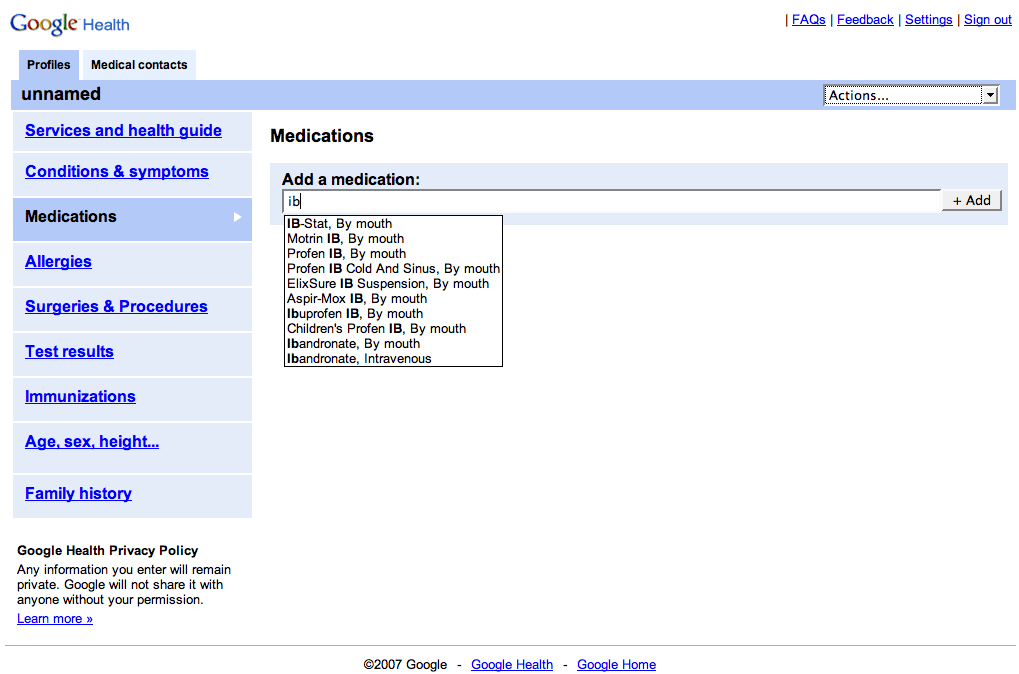
There are two tabs to be seen in Google Health: Profiles and Medical Contacts. The profiles tab has several sub-sections, including “Services and health guide,” “Conditions & symptoms,” “Medications,” “Age, sex, height...” and “Family history.”
A privacy policy at the bottom disclaims that “Any information you enter will remain private. Google will not share it with anyone without your permission.”


This “Conditions & symptoms” dialog includes an auto-completion feature, just like other input boxes in Google Health. You enter “head”, and Google suggests “Head and Neck Angioedema”, “Head Injury”, “Head Pain” and more.


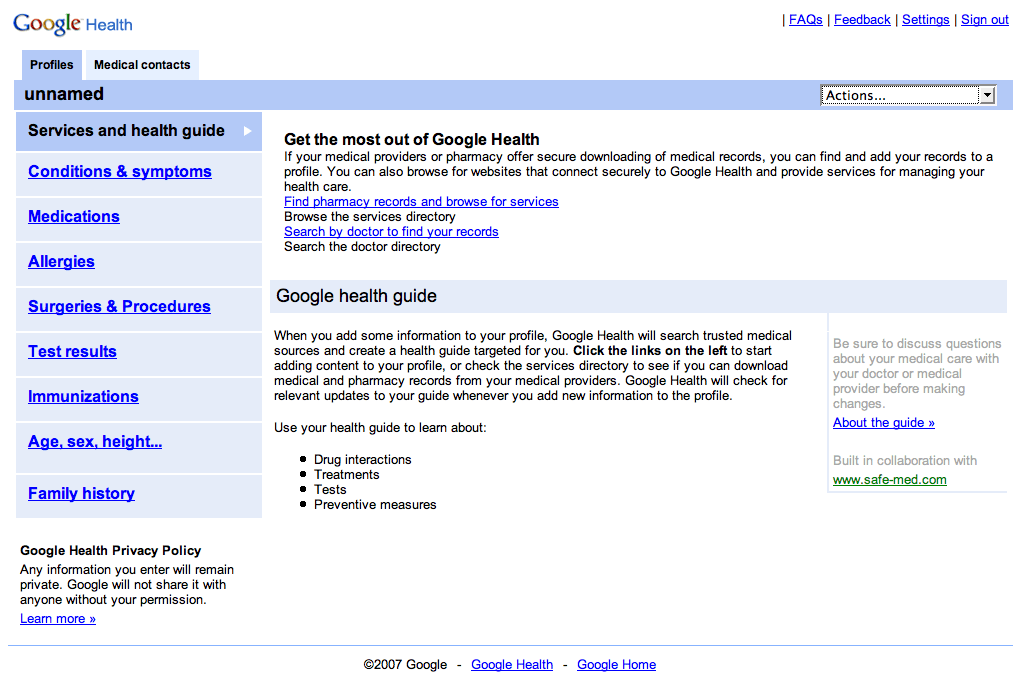
The “Services and health guide” section reads: “Get the most out of Google Health - If your medical providers or pharmacy offer secure downloading of medical records, you can find and add your records to a profile. You can also browse for websites that connect securely to Google Health and provide services for managing your health care.”
Under the headline “Google health guide” this explanation follows: “When you add some information to your profile, Google Health will search trusted medical sources and create a health guide targeted for you. ... Google Health will check for relevant updates to your guide whenever you add new information to the profile.” You can use the health guide, Google writes, to learn about drug interactions, treatments, tests and preventive measures.
A side box warns, “Be sure to discuss questions about your medical care with your doctor or medical provider before making changes,” and a footnote reads, “Built in collaboration with www.safe-med.com”.


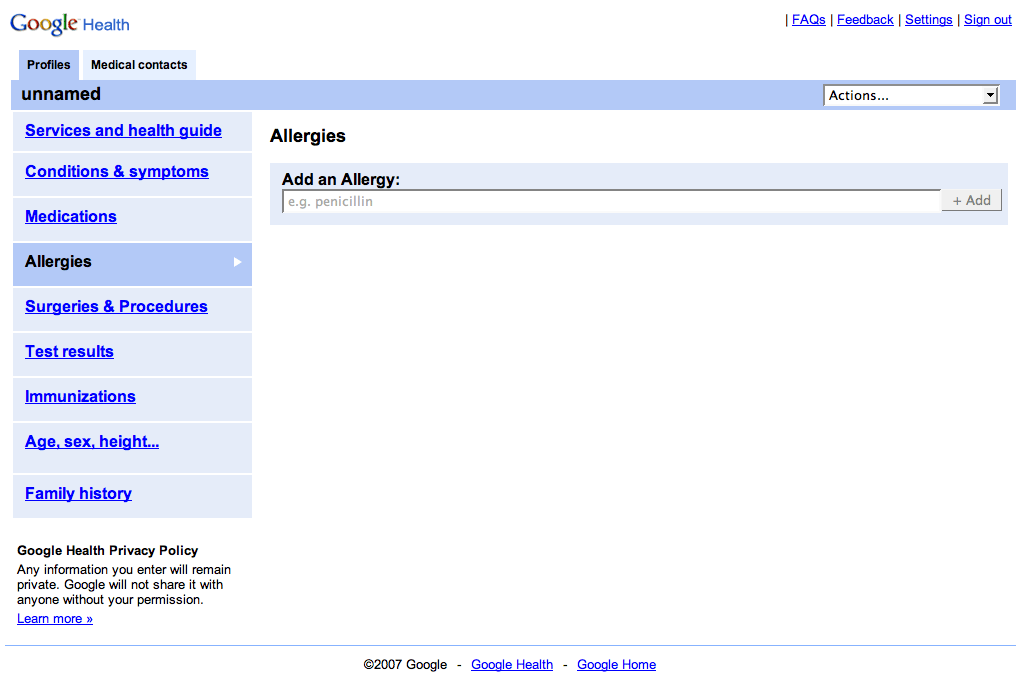
The “Allergies” tab. The “Add an Allergy” box suggests “e.g. penicillin.”


You can add a procedure or surgery on this page. As an example, Google provides “appendectomy.”


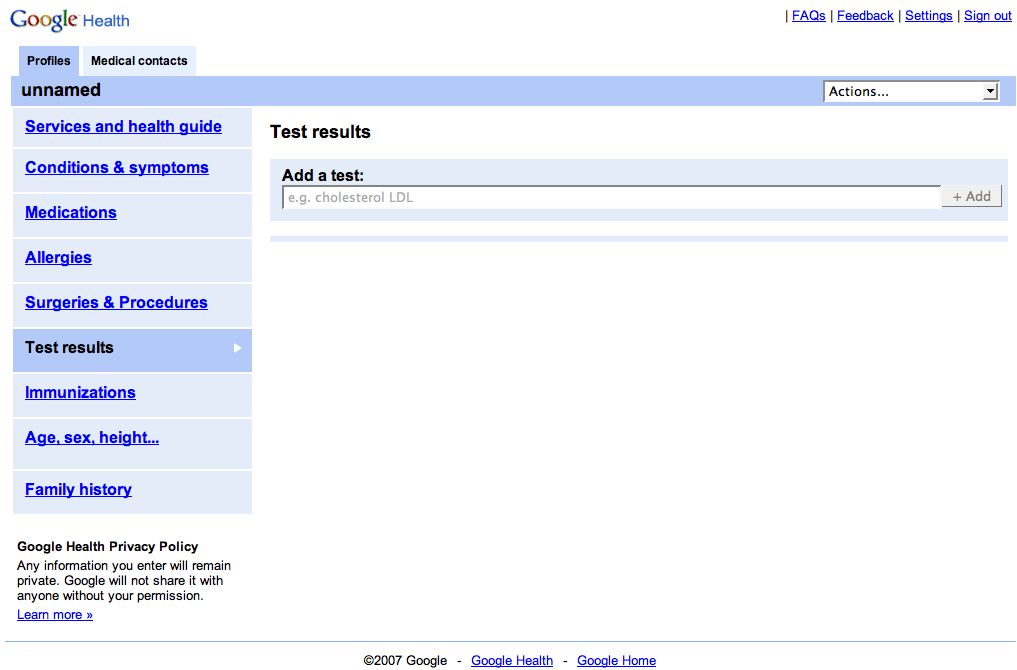
The “Test results” section. You can add e.g. “cholesterol LDL”.


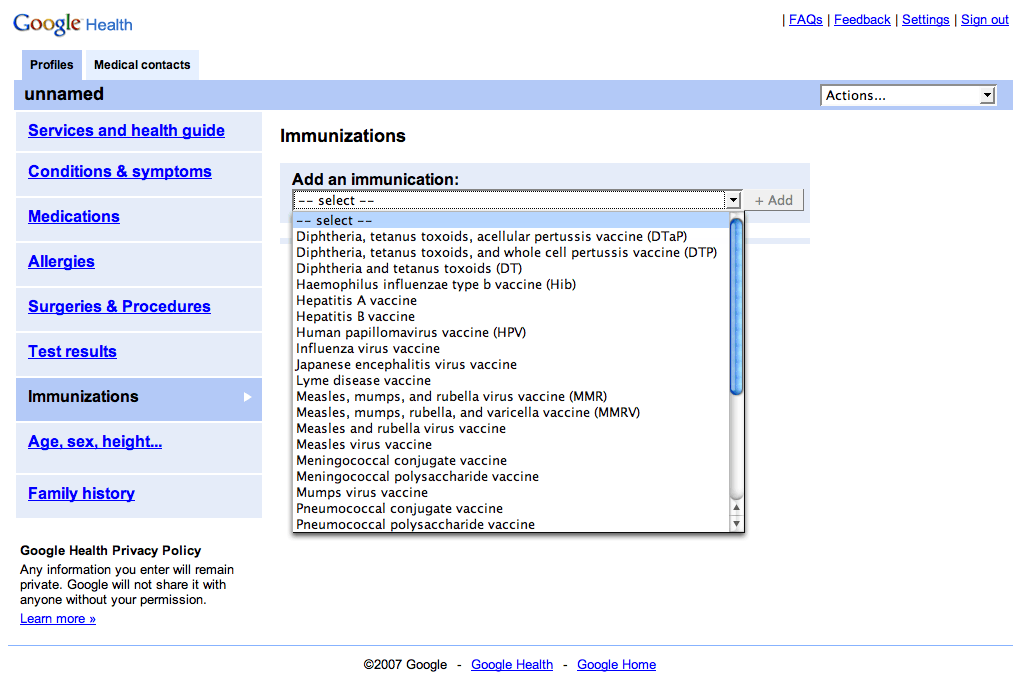
The “Add an immunication” interface does not allow free-style text input, but restricts you to a selection box instead. Available entries include “Diphtheria, tetanus toxoids, acellular pertussis vaccine (DTaP)” or “Hepatitis A vaccine.”


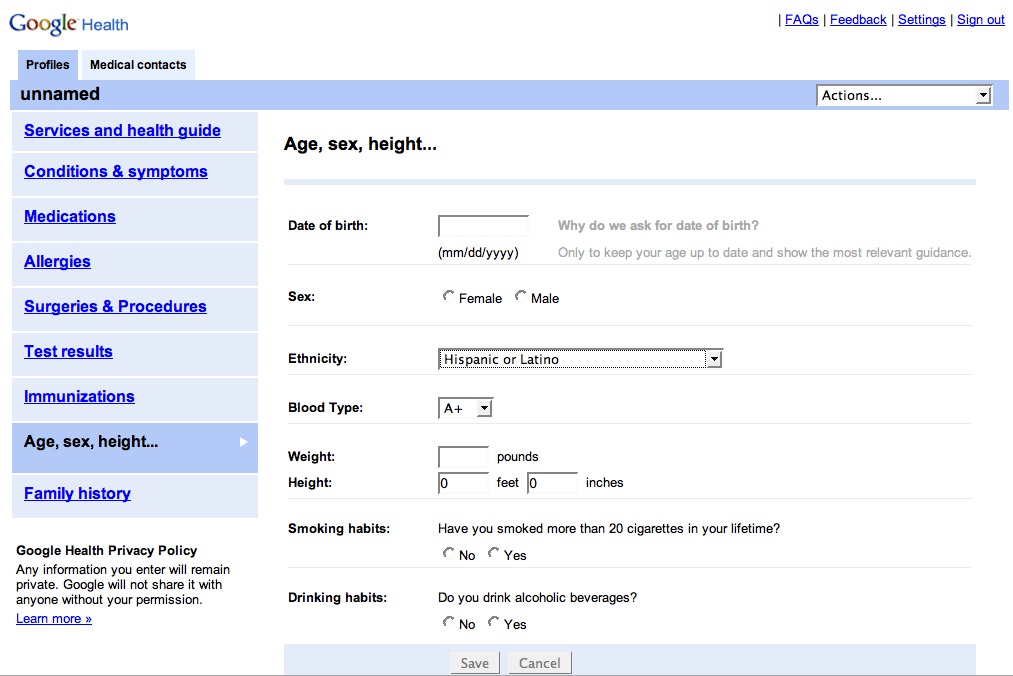
The “Age, sex, height...” page collects various personal information such as date of birth, gender, ethnicity, blood type, weight, or smoking habits. One of the questions asked is, “Do you drink alcoholic beverages?” Another question is, “Have you smoked more than 20 cigarettes in your lifetime?” Google explains that they ask for your date of birth to “keep your age up to date and show the most relevant guidance.”


The “Family history” dialog lets you add a relative and their respective conditions. The selection box includes entries like “Husband”, “Wife”, “Mother”, “Father”, “Son”, and Google provides the condition example “diabetes.”


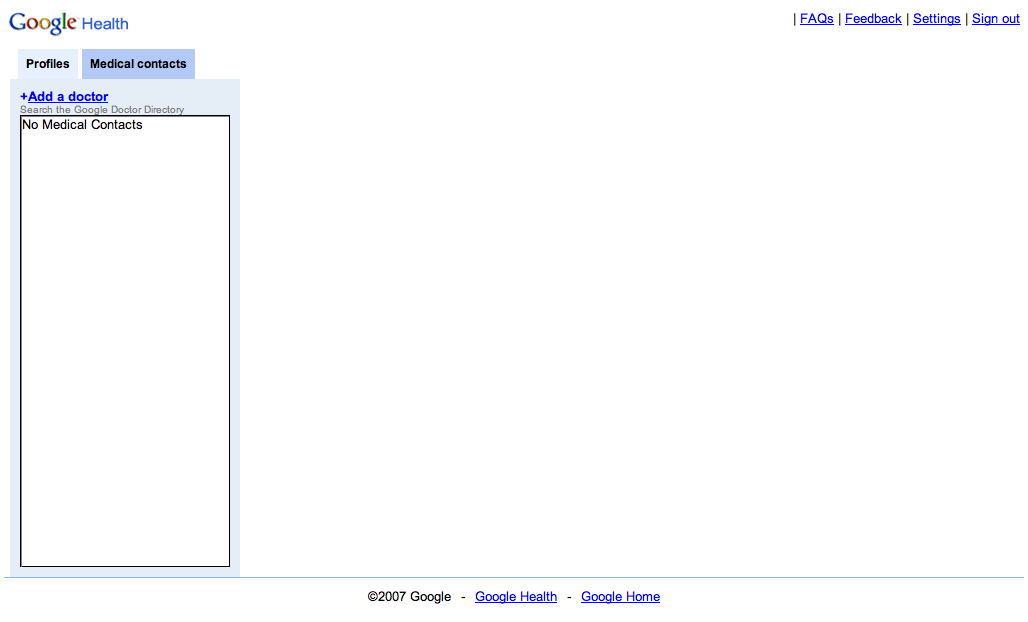
On this page, you can “add a doctor”. Our current unnamed sample patient has no medical contacts. You can search the “Google Doctor Directory” to find contacts.

Google Health Prototype

from: http://googlesystem.blogspot.com/2007/08/google-health-prototype.html


New York Times reports that Google's plans for a service that puts you in control of your health information start to take shape. This service could help you make more informed decisions about your health, get personalized recommendations from specialists and share this information with other people.

A prototype of Google Health, which the company has shown to health professionals and advisers, embodies the consumer-centered philosophy. The welcome page reads, "At Google, we feel patients should be in charge of their health information, and they should be able to grant their healthcare providers, family members, or whomever they choose, access to this information. Google Health was developed to meet this need."

A presentation of screen images from the prototype - which two people who received it showed to a reporter - then has 17 other Web pages including a "health profile" for medications, conditions and allergies; a personalized "health guide" for suggested treatments, drug interactions and diet and exercise regimens; pages for sharing information, receiving reminder messages to get prescription refills or visit a doctor, and pages to access directories for nearby physicians and specialists.


More about Google Health straight from the horse's mouth:

* Health care information matters - "Health information should be easier to access and organize, especially in ways that make it as simple as possible to find the information that is most relevant to a specific patient's needs."

* How do you know you're getting the best care possible? - "There is a lot of material out there about drugs, diseases, procedures and treatments. How do you know what is trustworthy and what isn't? Search is great at finding us places with relevant information, but it is hard to know which links are reliable and which are less so."

* Is there a doctor in the family? - "We have been talking to many medical experts to understand what the best guidelines are, and how we can determine which ones apply in different circumstances. If such guidelines were more available to patients, they might be able to, by inputting information such as age, gender or medications, learn about recommended screening tests and other preventive measures, or about harmful drug interactions."

* Some screenshots of the prototype.

{ The first screenshot is licensed as Creative Commons by Philipp Lenssen. The second image, where you can see Adam Bosworth (VP at Google and Google Health's architect), is licensed as Creative Commons by AlphachimpStudio. }

Sunday, May 13, 2007

2007 Interactive Media Award Winner for Healthcare

Healia Wins Outstanding Achievement Award for Health Search Website From Interactive Media Awards

BELLEVUE, WA -- (MARKET WIRE) -- May 03, 2007 -- Healia, a health vertical search engine for high quality and personalized health information, has won an Outstanding Achievement Award in the healthcare category from the 2007 Interactive Media Awards.

The honor, granted by the Interactive Media Council, recognizes Web sites that surpass the highest standards of excellence and that represent the Web's most professional and outstanding work. The judging criteria included design, usability, technical innovation, standards compliance, and content.

"We are honored to have our search engine recognized by the Interactive Media Awards," stated Tom Eng, CEO of Healia, Inc. "This award reflects Healia's passionate focus on building unique consumer health Internet technologies that have the highest levels of compelling design, usability, and innovation."

About Healia.com

Healia, Inc. (www.healia.com) is the creator of a proprietary, health-optimized search engine that uses patent-pending technology to generate high quality, highly targeted, and personalized results for consumers. The Healia search engine is available to partners for free in an advertising revenue share relationship or for a license fee to maintain an ad-free environment common to health organizations and employers. Its licensees include the Veterans Health Administration (VHA), the nation's largest integrated health care system.

About the Interactive Media Awards

The Interactive Media Awards (www.interactivemediaawards.com) recognize the highest standards of excellence in Web site design and development and honor individuals and organizations for their outstanding achievement. Sponsored by the Interactive Media Council, Inc., a nonprofit organization of leading Web designers, developers, programmers, advertisers and other Web-related professionals, the competition seeks to elevate the standards of excellence on the Internet.

Contact:

Tassie DeMoney
Healia, Inc.
12505 Bel-Red Rd., Suite 209
Bellevue, WA 98005
Phone: 425 646 6030
Email:
media@healia.com
Website: www.healia.com


Source: Market Wire

Tuesday, May 1, 2007

Mobiles 'to help track diseases'

Tuesday, 17 October 2006, 11:23 GMT

Village in Africa
The application can deliver information in remote locations
Mobile phone technology is being developed to help manage the spread of diseases such as HIV and bird flu.

The software is designed to allow field workers using handsets to send and receive data on disease outbreaks along with patient and drug information.

The project is a collaboration between technology firm Voxiva and the trade association for mobile operators, GSMA.

Trials of the relatively low-cost application are underway in Rwanda, Africa and in Indonesia.

When a disease is spreading rapidly, health authorities need information that is bang-up-to-date
Rob Conway, GSMA

The program works by sending the data through the general packet radio service (GPRS) network, and if this is unavailable, it can divert to an SMS data channel, normally used for text messages.

It is programmed using java language, so can work across different handsets and operators.

This means a doctor working in the field can send information to a central database about how many people are affected by a disease, patient status, drug inventory levels and receive information such as alerts, treatment guidelines or lab test results.

Ben Soppitt, director of strategic initiatives, GSMA, said: "This will allow health officials to see real-time accurate data on the status of the healthcare system in their country so they can make informed decisions about where those resources are applied."

'Vital data'

GSMA and Voxiva said the technology will be particularly valuable for helping to track communicable diseases, such as HIV. A pilot to the system's ability to track bird flu is also taking place in Indonesia.

Rob Conway, CEO of GSMA, said: "The efforts of the international health community to control pandemics, by getting life-saving drugs to those in need, depend heavily on a comprehensive and accurate picture of what is happening on the ground.

"When a disease is spreading rapidly, health authorities need information that is bang-up-to-date. Mobile networks, which are now widespread in the developing world, are the best and most immediate way to get them that vital data."

The cost of rolling out the technology in Rwanda, including setting-up and implementation costs, is about $1m.

Source: BBC
http://news.bbc.co.uk/1/hi/technology/6058162.stm

RELATED INTERNET LINKS